
Autumn driving.
Challenging Road Conditions – Part 1
Autumn driving , especially in late evening, is definitely another kettle of fish challenge compared to a Sunday drive in the middle of the beautiful sunny day.
Everyone agrees on that.
But what exactly we may encounter on the road at this time of year?
First of all – pitch darkness! 🙂
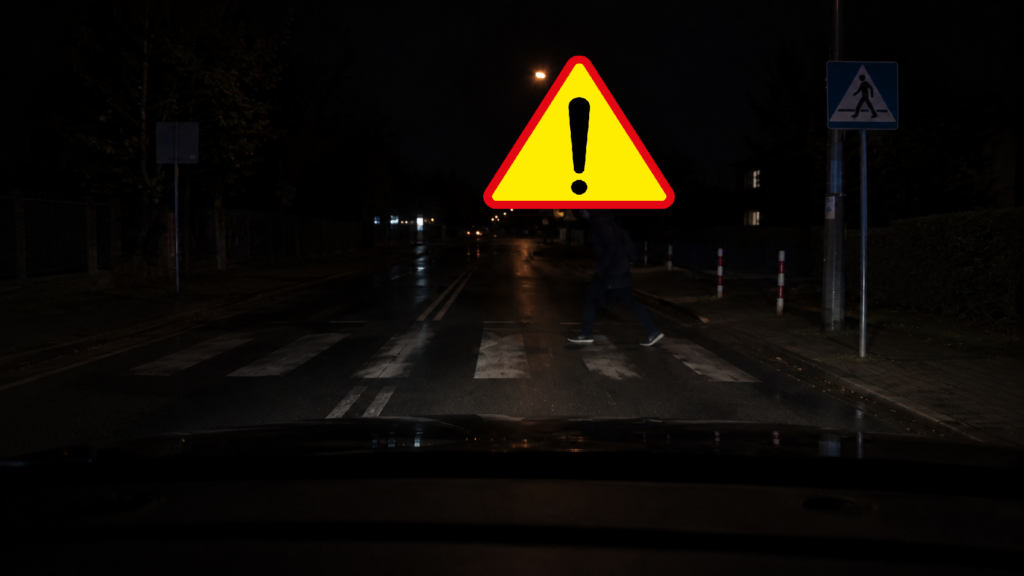
None of us particularly enjoys the situation when calmly driving home from work on a November evening, we suddenly have to test our emergency braking skills because some… pedestrian has just emerged out of Nowhere at a poorly lit pedestrian crossing.
Even better if dressed all in black (black never goes out of fashion, after all), with the hood pulled far and…the headphones. We can beraly see him and he…sees nothing.
Of course, according to Traffic Law, drivers are required to exercise extreme caution at every pedestrian crossing.
But… on a rainy autumn evevning sych pedestrian can quite literally… blend into the background.
What can we do as drivers?
We can’t prevent everything, but one thing we can certainly do is consistently follow the rules on exercising extreme caution. Above all, we should maintain an appropriate safe speed, giving ourselves enough time to react in an emergency.
Additionally, in places with limited visibility, it’s good practice even to even keep your foot ready over the brake pedal.
What should vulnerable road users do?
PEDESTRIANS
Let’s briefly remind ourselves of some of the responsibilities pedestrians have.
The obligation to wear reflective elements.
Under Article 11(4a) of the Polish Road Traffic Act, pedestrians walking along a road after dark and outside built-up areas are required to use reflective elements in a way that makes them clearly visible to other road users.
This is a clear-cut situation in which pedestrians are legally required to wear reflective elements.
The exceptions are: pavements/footways, pedestrian and cycle paths, and cycle paths. In other words, pedestrians are required to use reflective elements when walking on the carriageway or road shoulder.
And, of course, let’s remember that when walking on the carriageway or road shoulder, pedestrians must walk on the left-hand side of the road.
VISIBILITY
The fact that the legal requirement to wear reflective elements applies only in certain circumstances does not mean that a pedestrian, or indeed any other road user, has no responsibility for maintaining visibility.
This obligation already follows from Article 3 of the Polish Road Traffic Act, which states, among other things, that every road user must:
- Exercise caution.
- Exercise extreme caution – including when crossing the road at a marked pedestrian crossing.
- Avoid any action that could endanger road safety or disrupt traffic.
- Avoid any action that could disturb the orderly flow of traffic.
- Avoid any action that could put anyone at risk of harm.
PLEASE NOTE: By “action” the Law means also an omission (failing to do something when action is required).
Question: Is a pedestrian a road user? Absolutely.
Can stepping directly in front of an approaching vehicle create a dangerous situation? Of course. It is explicitly prohibited by traffic regulations.
The danger is even greater in conditions of reduced visibility or in places where visibility is limited – for example, at a poorly lit pedestrian crossing.
So, wouldn’t failing to wear any visible or reflective clothing when walking in places with… varying levels of visibility also count as an omission?
How about bicycls, e-scooter and personal transport devices?
Unlike pedestrians, these road users are not generally subject to a requirement to wear reflective elements.
However, when riding the above-mentioned vehicles, they are required to use appropriate lighting.
The requirements for all the above types of vehicles are quite similar and include:
- Front: a white or yellow light.
- Rear: a red light.
- Rear: a red reflector (other than triangle).
Additionally, electric scooters are required to have side reflectors on both sides.
People riding these vehicles should never neglect their mandatory lights in conditions of reduced visibility (after dark or in adverse weather conditions). Unfortunately, this is still something we see far too often.
Of course, we’re not trying to shift responsibility away from drivers here. 🚗
WE also have our own responsibilities. In this context, we should certainly make sure to exercise particular caution, and also remember to:
- Keep our windows and mirrors clean.
- After dark, always use the required lights (dipped headlights).
- Use full-beam headlights appropriately. When driving outside built-up areas at night, they give us considerably more time to react. However, in rain and/or fog, they can actually… make things worse.
Shifting responsibility from one group of road users to another does absolutely nothing to improve safety or traffic order on our roads.
Remember, when it comes to road safety, it’s pretty hard to be “too visible”. 🙂
The best and most effective approach is to educate ALL road users about SHARED RESPONSIBILITY – if we genuinely care about safety, rather than simply looking for someone to blame.
Fun fact;
Did you know that riding a horse on a paved road is prohibited in conditions of reduced visibility?
So, ride a horse on paved roads, only in good weather! 🙂
(Article 36.1 of the Polish Road Traffic Act.)